
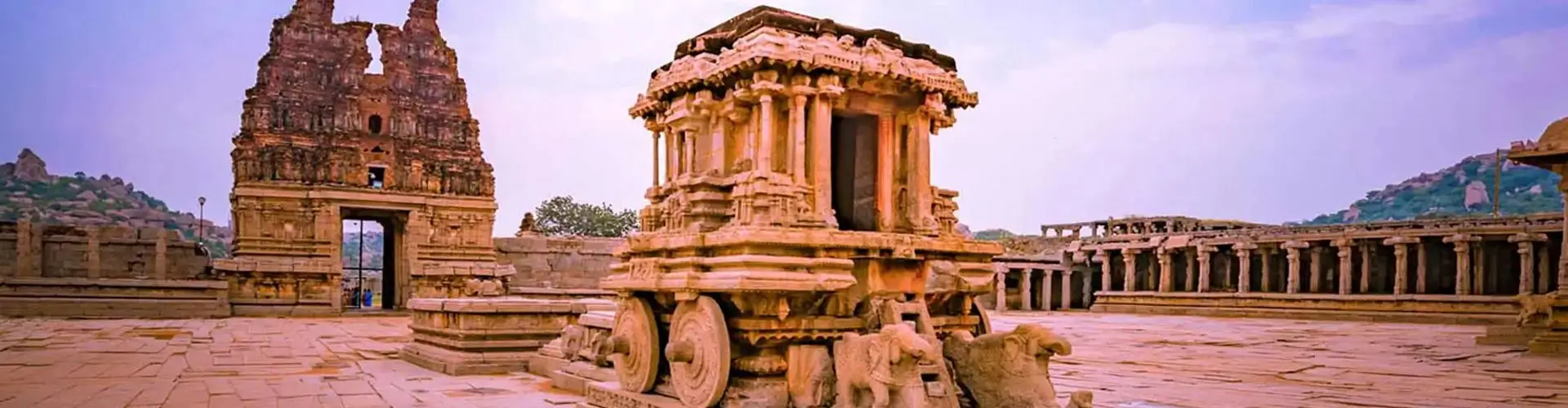
This itinerary is curated for travellers fascinated by ancient science, architectural intelligence, and early engineering systems. Set in Karnataka’s Deccan landscape, the journey examines how geometry, acoustics, hydraulics, and spatial planning shaped temple construction and royal cities centuries ahead of their time.
Designed with expert-led interpretation and measured pacing, the route allows detailed observation rather than surface-level sightseeing. Each destination contributes to an understanding of how ancient builders combined mathematics, ritual, and material knowledge to create enduring architectural systems.
On arrival in Hampi, the day begins at the Vitthala Temple complex, known for its 56 musical pillars. Accompanied by a specialised guide, you examine how variations in stone density and carving precision produce distinct tonal sounds when gently tapped. The focus remains on ancient knowledge of resonance, proportion, and material selection.
The second half of the day studies the broader temple layout, including axial alignment, mandapa placement, and processional pathways. Discussions centre on how sound, ritual movement, and geometry were intentionally integrated into sacred space, reflecting advanced understanding of sensory design.
The morning is dedicated to the Mahanavami Dibba, the ceremonial platform used for royal events. From elevated viewpoints, you analyse city planning, audience visibility, and the strategic placement of royal enclosures within the Vijayanagara capital.
Later, attention turns to the Lotus Mahal and Elephant Stables, where passive cooling techniques were employed through ventilation corridors, water channels, and shaded courtyards. These structures demonstrate how climate-responsive architecture was achieved without mechanical systems, relying instead on airflow and spatial geometry.
After breakfast, you depart Hampi by road toward Badami, passing through rocky terrain characteristic of the Deccan plateau. The changing landscape prepares context for the rock-cut architecture encountered upon arrival.
In Badami, visits to the 6th-century cave temples focus on how entire sanctuaries were carved directly from red sandstone cliffs. Detailed interpretation highlights chisel techniques, load distribution, and iconographic planning, revealing the engineering precision required to remove material rather than assemble it.
The day begins with a visit to Aihole, often referred to as the cradle of Indian temple architecture. Here, early experiments transitioning from wooden structures to stone construction are examined, offering insight into structural trial-and-error and evolving design logic.
Later, the journey continues to Pattadakal, a UNESCO World Heritage Site where northern and southern architectural styles coexist. The temples provide clear examples of proportional geometry, structural symmetry, and refined stone craftsmanship, marking a mature stage in temple engineering.
The final day returns to Hampi for a focused visit to Hemakuta Hill. Jain temples scattered across the hilltop are studied for their geometric alignment with sunrise, cardinal directions, and surrounding landmarks.
As the sun lowers, a photography session allows time to observe spatial relationships between structures and landscape. The journey concludes with transfer arrangements to Hospet or Bangalore, bringing closure to a route shaped by ancient intelligence and architectural mastery.
Enquire now and connect with a dedicated Travel Expert who will respond within 24 hours to begin crafting your private journey.

Dev
Travel Expert
12+ yrs experience

Have a look at our original experiences and then contact us with your questions, or call +91-9351360903

Our Experts will send you a detailed holiday itinerary specified to your desires. It's our service promise to you.

Tailor-made doesn't mean expensive! Ask about our price promise and book with financial security.

Cochin - Munnar - Thekkady - Kumarakom

Yes, explanations are clear and accessible for all interested travellers.
Yes, guides with architectural and historical expertise accompany the tour.
Moderate walking is involved across uneven terrain.
Yes, guidance is provided on composition and alignment.
Yes, for families interested in history and architecture.
Its integration of geometry, acoustics, and urban planning.
Yes, Hampi and Pattadakal are UNESCO-listed.
Yes, focus areas can be adjusted.
November to February offers the most comfortable conditions.
Yes, sacred geometry and ritual planning are integral themes.