
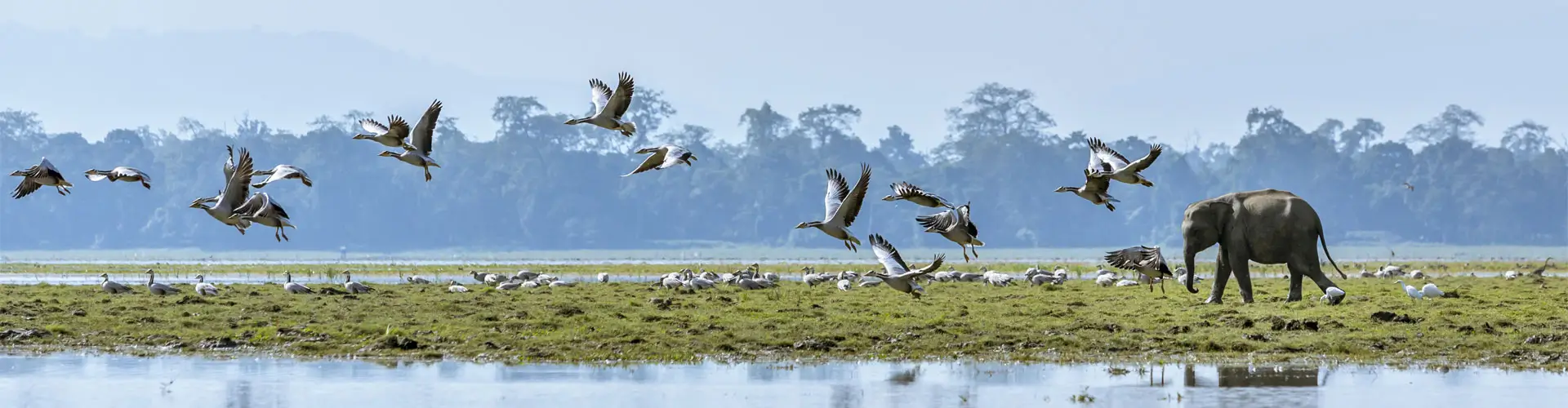
The “Other” Wild India is designed for wildlife travelers who want to move beyond the usual tiger narrative and explore India’s lesser-known but equally remarkable ecosystems. This journey highlights species and landscapes that exist nowhere else in the world - one-horned rhinoceros, Asiatic lions, Indian wild asses, river dolphins, and salt-desert specialists.
The route begins in Assam’s Brahmaputra floodplains, where grasslands, wetlands, and forests merge to support high densities of megafauna and birds. From here, the journey transitions to Majuli, the world’s largest river island, offering cultural context shaped entirely by water and erosion. The second half moves westward into Gujarat, tracing dry forests and saline deserts where wildlife survival depends on adaptation rather than abundance.
This itinerary is ideal for seasoned wildlife enthusiasts, photographers, and conservation-focused travelers who seek diversity, geographic contrast, and ecological understanding rather than repetitive safari formats.
Arrive at Guwahati Airport (GAU) and begin a scenic drive of approximately four and a half hours to Kaziranga National Park. The route follows the Brahmaputra valley, where vast floodplains support agriculture, wetlands, and rich biodiversity.
Arrive at your lodge near Kaziranga by afternoon and settle in. The evening is kept relaxed, allowing time to observe the surrounding landscape and prepare for early safari starts. Overnight stay near Kaziranga.
Begin early with a morning elephant safari, offering close-range but controlled encounters with the one-horned rhinoceros. The elevated vantage point allows observation of grazing behavior without disturbing animals in tall grass.
After rest and lunch, head out for an afternoon jeep safari into a different range of the park. Naturalists explain floodplain ecology, grassland regeneration, and how seasonal flooding supports high herbivore density. Evening at leisure. Overnight in Kaziranga.
Today shifts focus from land to water. Depart for the Brahmaputra River for a guided boat safari aimed at spotting endangered Gangetic river dolphins. The slow pace of the boat allows observation of surfacing patterns rather than chasing sightings.
The river also supports rich birdlife, turtles, and fishing communities. The experience highlights how river health directly impacts both wildlife and livelihoods. Return to the lodge by afternoon. Evening is free for rest and discussion.
Travel early to Agoratoli, Kaziranga’s easternmost range, known for its bird diversity and open landscapes. This zone attracts migratory species, raptors, and wetland birds, making it ideal for ornithology enthusiasts.
The slower safari pace encourages observation rather than movement. Naturalists focus on identification, behavior, and habitat use. The afternoon remains unstructured, allowing time to absorb the scale and openness of the floodplain ecosystem.
Drive to the river port and take a ferry to Majuli Island, the world’s largest inhabited river island. The crossing itself demonstrates the Brahmaputra’s scale and shifting channels.
Upon arrival, explore village life shaped by water, erosion, and seasonal migration. Visit local communities known for mask-making traditions used in classical Assamese theatre. Overnight stay on Majuli offers rare insight into a culture shaped entirely by river dynamics.
After breakfast, transfer to Jorhat or Guwahati Airport for a long-haul domestic flight to western India, routing via Delhi or Mumbai to reach Rajkot or Diu.
Upon arrival, continue by road to SasanGir, entering a completely different ecological zone. The transition from wet floodplains to dry deciduous forest highlights India’s extreme habitat diversity. Overnight stay near Gir National Park.
Spend the morning at leisure, allowing recovery after long travel. In the afternoon, enter Gir National Park for your first safari, focused on tracking the Asiatic Lion, the only wild population of its kind in the world.
The dry forest terrain offers relatively open visibility, allowing observation of lion behavior, pride structure, and movement patterns. Evening discussions compare predator dynamics here with those observed in Kaziranga. Overnight in Gir.
Begin the day with a morning safari in Gir National Park, entering a different route or zone from the previous day. Early hours are ideal for observing lions returning from night movement, often resting along forest tracks or near water sources. Naturalists explain pride hierarchy, territorial overlap, and how Gir’s dry deciduous forest shapes hunting strategy.
After lunch and rest, head out again for an afternoon safari. This second drive increases understanding of how light, temperature, and prey movement influence lion behavior. Evening discussions compare Asiatic lion ecology with African counterparts, highlighting adaptation to human-dominated landscapes.
After breakfast, depart Gir and begin the approximately six-hour drive to Dasada, the gateway to the Little Rann of Kutch. The journey reveals a gradual ecological shift—from wooded hills to flat, arid plains shaped by seasonal flooding and evaporation.
Arrive by late afternoon and witness your first sunset over the salt flats. As the horizon glows, the vast openness of the Rann becomes evident. The silence, scale, and reflective surface create a stark contrast to forest environments, preparing you for a completely different wildlife experience.
Set out early for a safari across the Little Rann’s unique terrain. This saline desert supports specialized species such as the Indian Wild Ass (Khur), desert fox, nilgai, and migratory birds. The open landscape allows long-range observation rather than close tracking.
Naturalists explain how seasonal monsoon flooding transforms the desert into wetlands, supporting breeding cycles. Afternoon remains relaxed, allowing recovery from morning exploration and time to absorb the region’s extreme environmental conditions.
Today focuses on the flamingo colonies that seasonally inhabit the Rann, creating one of the subcontinent’s most remarkable bird spectacles. Observation emphasizes nesting behavior, feeding patterns, and the delicate balance between salt production and bird habitat.
Later, visit nearby tribal villages, interacting with communities adapted to desert living. Discussions explore salt farming, livestock management, and how livelihoods coexist with wildlife protection. The day highlights human resilience within fragile ecosystems.
Drive approximately two hours to Ahmedabad, Gujarat’s largest city and a center of architectural innovation. After days in remote wilderness, the city offers a cultural and intellectual transition.
In the evening, participate in a guided heritage walk through the old city. Narrow pols, carved wooden houses, and hidden courtyards reveal urban planning shaped by climate and community. Overnight stay in Ahmedabad.
Begin the day with a visit to the Adalaj Stepwell, a masterpiece of subterranean architecture designed to manage water, temperature, and social space. The structure demonstrates how ancient engineering responded to arid environments.
Later, visit Sabarmati Ashram, where Mahatma Gandhi lived during India’s freedom movement. The calm simplicity contrasts with the architectural complexity seen elsewhere. The afternoon includes exploration of Ahmedabad’s UNESCO-listed modern architecture, highlighting continuity between tradition and innovation.
After breakfast, transfer to Ahmedabad International Airport (AMD) for your onward international departure. Transfers are scheduled according to flight timings to ensure a smooth end to the journey.
The “Other” Wild India concludes with a comprehensive understanding of India’s lesser-known wildlife—from floodplain giants and river dolphins to desert specialists and the world’s only Asiatic lions. The experience is defined by diversity, adaptation, and ecological contrast rather than repetition.
Enquire now and connect with a dedicated Travel Expert who will respond within 24 hours to begin crafting your private journey.

Dev
Travel Expert
12+ yrs experience

Have a look at our original experiences and then contact us with your questions, or call +91-9351360903

Our Experts will send you a detailed holiday itinerary specified to your desires. It's our service promise to you.

Tailor-made doesn't mean expensive! Ask about our price promise and book with financial security.

Delhi - Jaipur - Ranthambore - Udaipur - Jaisalmer - Jodhpur - Bharatpur - Agra - Delhi

Mumbai - Udaipur - Jodhpur - Bikaner - Jaipur - Ranthambore - Agra - Delhi

Bangalore - Hampi - Chikmagalur - Nagarhole - Coorg - Bangalore