Location : Jaipur
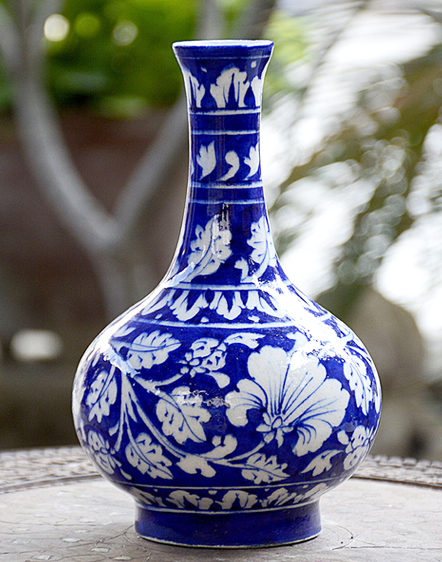
In the cultural heart of Jaipur, a craft flourishes that is as luminous and refined as the Pink City itself—Jaipur Blue Pottery. Distinguished from all other ceramic traditions of the world, this rare art form is created without the use of clay, relying instead on a sophisticated fusion of stone, glass, and natural minerals. Its glossy surface, intricate hand-painted motifs, and iconic shades of cobalt blue and turquoise have made it one of India’s most celebrated artistic legacies.
For the discerning traveler and connoisseur of heritage experiences, witnessing the creation of Blue Pottery is far more than a workshop visit—it is an encounter with centuries of patience, precision, and inherited wisdom. Each piece is the result of a meticulous, six-stage process where artistry and science work in perfect harmony.
Unlike conventional pottery that begins with earth, Blue Pottery starts with minerals. Artisans carefully measure and blend five key ingredients: Quartz, Raw Glass, MultaniMitti (Fuller's Earth), Katira (natural gum), and Sazi (salt). Each component plays a crucial role in strength, flexibility, and translucency.
The process begins at the Chakki, a traditional stone grinder where the minerals are crushed into a fine powder. This grinding is slow and deliberate, ensuring uniform texture. Water is then added to create a pliable dough, which is left to rest for nearly 12 hours. This aging period allows the minerals to bond naturally, giving the dough its unique workability and resilience—an essential foundation before shaping even begins.
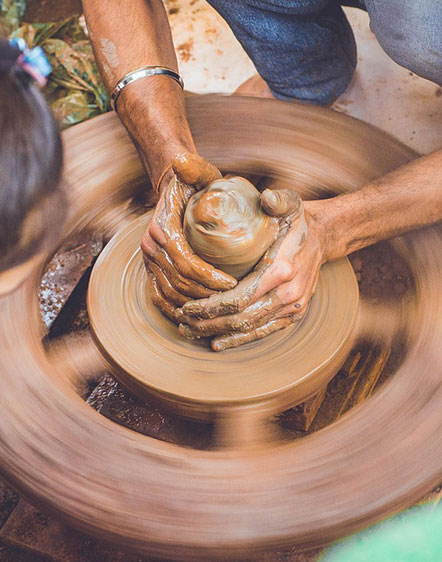
In contrast to most ceramic traditions, Blue Pottery is rarely thrown on a wheel. Instead, artisans rely on handcrafted molds that define each form.
The mineral dough is rolled into flat discs, much like a chapatti, and gently pressed into molds that shape plates, bowls, tiles, and decorative forms. To support the fragile structure, the molds are filled with burnt wood ash, which absorbs moisture and prevents collapse. After two days of sun-drying, the ash is carefully removed, and the piece is refined using sandpaper. This step gives the surface an almost porcelain-like smoothness, preparing it for further transformation.
Before decoration can begin, the porous body must be sealed. Artisans apply Asther, a brilliant white coating made from quartz and glass. This engobe layer serves as a pristine canvas, smoothing imperfections and creating a non-porous surface.
Asther is vital to the visual identity of Blue Pottery—it allows colors to sit vividly on the surface, enhancing contrast and lending the finished piece its unmistakable brightness and clarity.
This stage is where the soul of the craft truly emerges. Using fine brushes traditionally made from squirrel hair, master artisans paint intricate floral vines, Persian-inspired motifs, birds, and geometric patterns.
The colors are derived from natural metal oxides—cobalt for deep blues, copper for turquoise, manganese for subtle blacks and browns. Every line is painted freehand, without stencils or guides. The artisan relies entirely on muscle memory, rhythm, and generations of passed-down skill, making each piece subtly unique and impossible to replicate exactly.
To achieve its signature glass-like finish, Blue Pottery is coated with a transparent glaze. This glaze is prepared by melting glass, borax, and lead oxides in a kiln. The molten mixture is rapidly cooled in water to create a brittle substance called frit, which is then ground into a fine powder.
Mixed into a liquid paste, the glaze is brushed over the painted surface, forming a protective layer that enhances color depth while sealing the design beneath a luminous sheen.
The final stage is the most critical and unpredictable. Before firing, many artisans perform a quiet prayer, acknowledging the risks involved.
The pottery is placed inside a kiln and slowly heated to 800–850°C over nearly eight hours. Precision is essential—too much heat can cause cracks, too little can dull the glaze. Once firing is complete, the kiln remains sealed for three full days, allowing the pieces to cool gradually. Only then are they revealed—translucent, radiant, and timeless, their colors permanently fused beneath glass.
We invite you to step inside private ateliers and heritage studios where Jaipur's master craftsmen work away from commercial crowds. Under the guidance of award-winning artisans, guests can observe every stage of the process—or even try painting their own motif as a personal keepsake.
This immersive experience offers rare access to one of India's most refined craft traditions, making it an essential cultural highlight for travelers seeking authenticity, artistry, and luxury rooted in heritage.

Enquire now and connect with a dedicated Travel Expert who will respond within 24 hours to begin crafting your private journey.

Dev
Travel Expert
12+ yrs experience

Have a look at our original experiences and then contact us with your questions, or call +91-9351360903

Our Experts will send you a detailed holiday itinerary specified to your desires. It's our service promise to you.

Tailor-made doesn't mean expensive! Ask about our price promise and book with financial security.